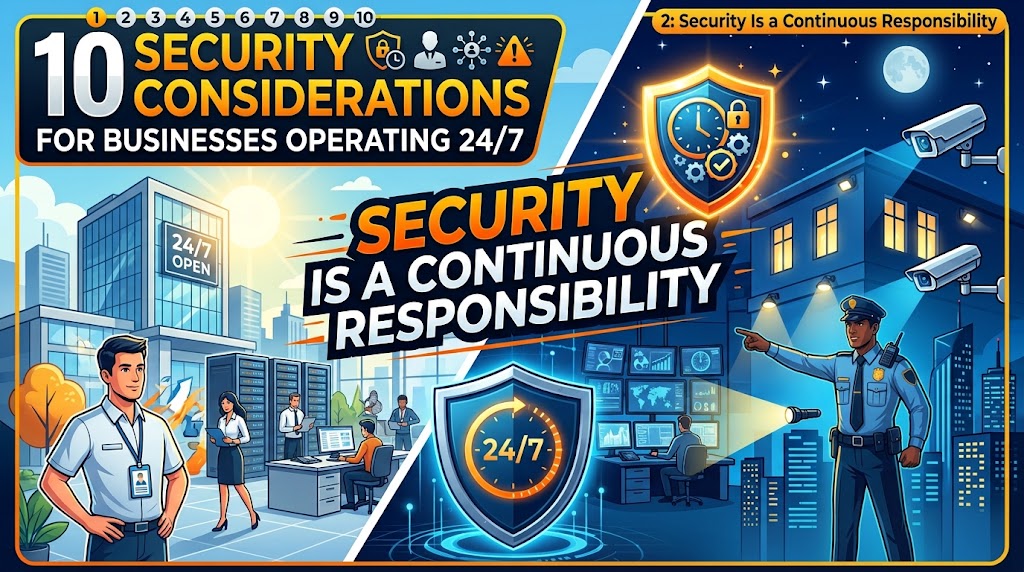
Your business may operate around the clock, but can your security system do the same?
For businesses that operate 24 hours a day, security cannot be treated as a daytime responsibility. While employees may work in shifts, customers may come and go, deliveries may arrive at different hours, and critical operations may continue through the night, security risks also remain active.
In fact, some security vulnerabilities can become more pronounced during periods of reduced activity. Fewer employees, limited management presence, reduced visibility, and lower human traffic can create opportunities for theft, unauthorized access, vandalism, workplace incidents and other security threats.
Whether you operate a hospital, hotel, warehouse, factory, logistics company, financial institution, residential facility, retail business, filling station, technology facility or other 24/7 operation, your security strategy should be designed around continuous protection.
Here are 10 important security considerations for businesses operating around the clock.
1. Adequate Security Personnel Coverage
Having security personnel on site is not enough. The right number of trained, vetted and properly supervised personnel must be available for every shift.
A business that is well protected during the day can become vulnerable at night if there are insufficient personnel to monitor entrances, patrol the premises, respond to incidents and maintain communication with management.
Security staffing should therefore be determined by factors such as the size of the facility, number of access points, location, operating hours, nature of the business, level of risk and number of employees or visitors.
Businesses should also have contingency arrangements for absenteeism, emergencies, public holidays and unexpected increases in operational activity.
2. Effective Shift Handover
One of the most overlooked security risks in 24/7 operations is poor communication between shifts.
Imagine that a security officer notices suspicious activity around the perimeter at 6:00 p.m. but fails to properly brief the incoming night team. The next team may unknowingly ignore the same area, leaving the business exposed.
A structured handover should communicate relevant information such as:
- Incidents recorded during the previous shift
- Suspicious persons or activities
- Visitors and contractors still on site
- Faulty security equipment
- Access-control concerns
- Areas requiring special attention
- Outstanding instructions from management
A strong handover ensures that security information does not end when a shift ends.
3. Strong Access Control
Who is entering your premises at 2:00 a.m.? This is a question every 24/7 business should be able to answer.
Access control should remain effective regardless of the time of day. Employees, contractors, visitors, suppliers and service providers should have clearly defined access permissions.
Depending on the nature of the business, appropriate measures may include:
- Identification checks
- Visitor management systems
- Access cards
- Biometrics
- Security gates and barriers
- Visitor registers
- Vehicle checks
- Restricted-area controls
- Authorization procedures
Particular attention should be given to after-hours access, when fewer management personnel may be available to verify unusual requests.
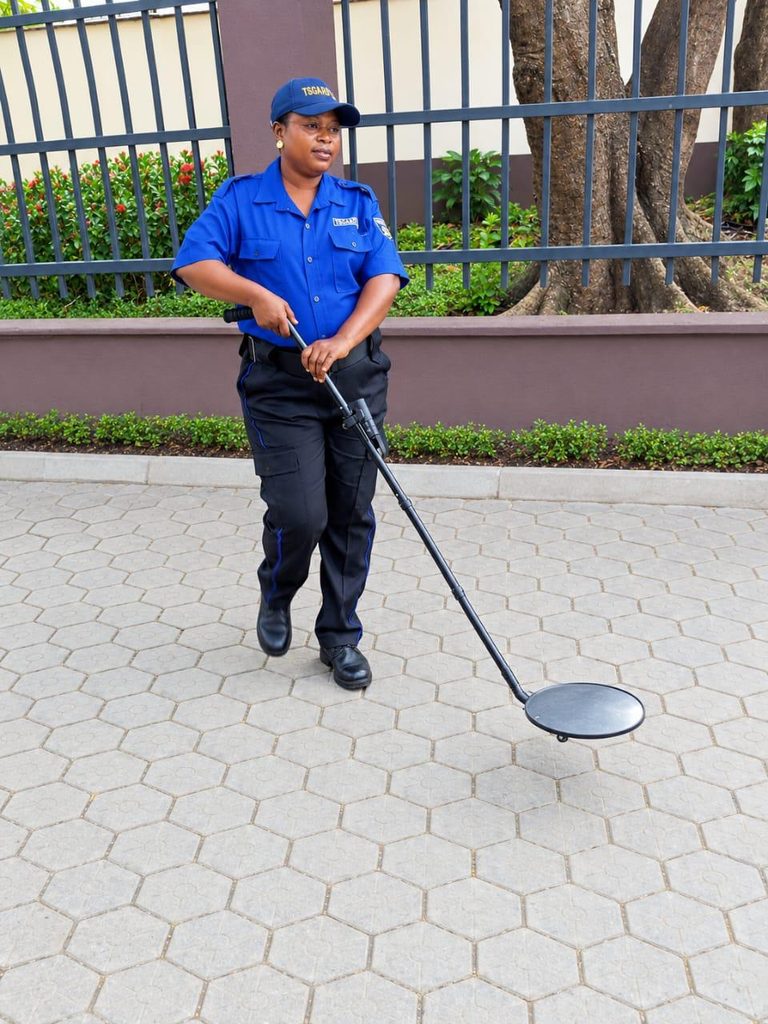
4. CCTV and Continuous Security Monitoring
Technology can significantly strengthen a 24/7 security operation, but only when it is properly managed.
CCTV should cover strategically important areas such as entrances, exits, parking areas, warehouses, production facilities, cash-handling areas, corridors and perimeter zones.
However, installing cameras is only the beginning.
Businesses should regularly confirm that cameras are functioning, recording correctly and providing adequate visibility. Blind spots should be identified and addressed.
Where appropriate, CCTV should also be integrated with trained monitoring personnel who can identify suspicious activity and escalate incidents quickly.
A camera that is installed but not monitored, maintained or reviewed may provide a false sense of security.
5. Conduct Night-Time Vulnerability Assessments
Your business may look secure at 10:00 a.m. and completely different at 2:00 a.m.
Lighting conditions change. Employee presence reduces. Some entrances may become less active. Certain areas may become isolated. Security personnel may also face different challenges.
This is why businesses operating 24/7 should conduct periodic night-time security assessments.
These assessments can identify:
- Poorly illuminated areas
- CCTV blind spots
- Unsecured doors and windows
- Weak perimeter sections
- Isolated parking areas
- Uncontrolled access points
- Areas where security personnel have limited visibility
- Emergency routes that may be difficult to use at night
Security assessments should not only ask, “Is there a guard on duty?” They should ask, “What could happen here tonight that may not happen during the day?”
6. Emergency Response Preparedness
Emergencies do not wait for management to arrive.
A fire, medical emergency, theft, intrusion, violent incident, equipment failure or other crisis can occur at any hour. A business operating 24/7 must therefore have clear emergency response procedures.
Employees and security personnel should understand:
- Who to contact
- What immediate actions to take
- When to escalate the incident
- Emergency evacuation procedures
- Assembly points
- How to contact emergency services
- Management escalation channels
- Procedures for preserving the scene after an incident
The objective is not simply to react to an emergency but to reduce confusion and response time when one occurs.
7. Protect Employees and Contractors Working at Night
Night-shift employees can face unique security and safety challenges.
Employees arriving or leaving at unusual hours may be exposed to risks around parking areas, transport points, isolated walkways and external areas.
Businesses should consider measures such as adequate lighting, controlled access, security escorts where appropriate, emergency communication channels, safe parking arrangements and procedures for reporting suspicious activity.
Contractors and service providers working outside normal business hours should also be properly identified and authorized.
Employee safety is not separate from business security. A workforce that feels unsafe can also become less productive and less confident in the workplace.
8. Strengthen Perimeter Security and Patrols
The perimeter is often the first line of physical protection.
Regular patrols can help identify unusual activity, damaged fencing, open gates, suspicious persons, unsecured areas and other potential vulnerabilities before they develop into serious incidents. As for larger facilities, patrols should cover both internal and external areas and should be properly documented.
Supervisors should also verify that patrols are actually being conducted rather than relying solely on written reports where appropriate, patrol patterns should avoid becoming completely predictable. A security routine that is easy to anticipate can create opportunities for individuals attempting to exploit the system.
9. Incident Reporting and Security Intelligence
Every incident contains information that can help improve security.
A minor access violation today may reveal a larger weakness tomorrow. Repeated equipment failures may indicate a neglected security vulnerability. Multiple reports of suspicious activity around the same location may point to a developing threat.
Businesses should therefore maintain proper records of the following: Security incidents, Suspicious activities, Access violations, Theft or loss Property damage, Safety concerns, Equipment failures, Staff complaints and Security observations
Management should periodically review these reports to identify patterns, trends and recurring vulnerabilities. Good security is not only about responding to incidents. It is also about learning from them.
10. Regularly Review and Improve Security Measures
Security threats change, businesses change and operating environments change.
A security arrangement that was suitable two years ago may no longer provide adequate protection today. Businesses should periodically review their security arrangements following:
- Major incidents
- Changes in business operations
- Expansion to new locations
- Changes in staffing
- Introduction of new technology
- Changes in the surrounding environment
- Emerging security threats
- Feedback from employees and security personnel
Security reviews should answer a simple question: “If someone wanted to exploit our business today, where would they look for a weakness?” The answer can help management identify where additional controls, training, technology or security personnel may be required.
Security Is a Continuous Responsibility and protection requires a coordinated system involving people, procedures, technology, supervision, intelligence, access control and emergency preparedness.
Most importantly, businesses should avoid treating security as a one-time investment. Security should be continuously assessed, tested and improved.
Because while your business may operate 24 hours a day, security gaps can emerge in seconds.
We understand that every business has different operational realities and security requirements. Effective security begins with understanding the environment, identifying vulnerabilities and implementing practical measures designed around the client’s risk profile.
Your security is our priority.
By: Agbolade Joshua.O AIIPS,CSPC,CSPM,APRCMI-UK